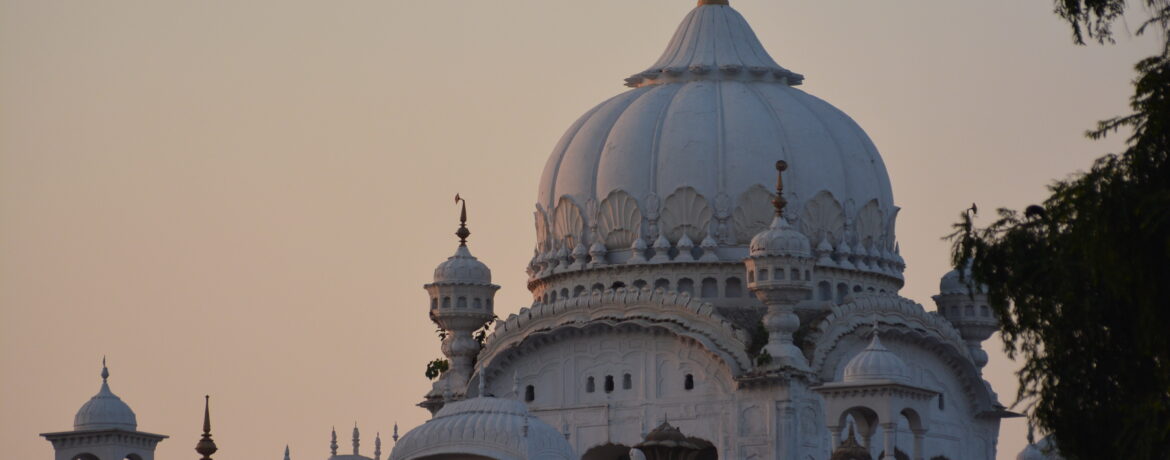
The Badshahi Mosque , Imperial Mosque) in Lahore was commissioned by the sixth Mughal Emperor Aurangzeb. Constructed between 1671 and 1673, it was the largest mosque in the world upon construction. Today it is the second largest mosque in Pakistan and the fifth largest mosque in the world. It is Lahore’s most iconic and famous landmark and a major tourist attraction.[1] Aurangzeb’s mosque’s architectural plan is similar to that of his father ([Shah Jehan]) the Jama Masjid in Delhi; though it is much larger. it also functions as an idgah. The courtyard which spreads over 276,000 square feet, can accommodate one hundred thousand worshippers and ten thousand worshippers can be accommodated inside the mosque. The minarets are 196 feet (60 m) tall. The Mosque is one of the most famous [Mughal] structures, but suffered greatly under the reign of Maharaja [Ranjit Singh]. In 1993, the Government of Pakistan included the Badshahi Mosque in the tentative list for UNESCO World Heritage Site. History 1671–1849 The mosque was constructed by the sixth Mughal emperor Aurangzeb, who, unlike the previous emperors, was not a patron of art and architecture. The mosque was built between 1671 and 1673 by him under the guidance of Fidai Khan Koka, who was his « master of ordinance ».[5] Duleep Singh entering the mosque On 7 July 1799, the Sikh army of the Sukerchakia chief, Ranjit Singh, took control of Lahore.[6] After the capture of the city, the Badshahi mosque was desecrated[7] by Ranjit Singh, who used its vast courtyard as a stable for his army horses, and its 80 hujras (small study rooms surrounding the courtyard) as quarters for his soldiers and as magazines for military stores. Ranjit Singh used the Hazuri Bagh, the enclosed garden next to it, as his official royal court of audience.[8] In 1818, he built a marble edifice in the garden facing the mosque.[9] In 1880s with broken minarets In 1841, during the First Anglo-Sikh War, Ranjit Singh’s son, Sher Singh, used the mosque’s large minarets for placement of zamburahs or light guns. It was used to bombard the supporters of Chand Kaur taking refuge in the besieged Lahore Fort, inflicting great damage to the fort itself. In one of these bombardments, the fort’s Diwan-e-Aam (Hall of Public Audience) was destroyed (it was subsequently rebuilt by the British but it could not be exactly restored in the previous state).[1] During this time, Henri De la Rouche, a French cavalry officer employed in the army of Sher Singh,[10] used a tunnel connecting the Badshahi mosque to the Lahore fort to temporarily store gunpowder.[11] In the 1870s In 1849 during the British Raj, the British continued using the mosque and the adjoining fort as a military garrison. The 80 cells (hujras) built into the walls surrounding the its vast courtyard on three sides were originally study rooms, which were used by the Sikhs under Ranjit Singh to house troops and military stores.